“Just in Case”
I guess I could be called a tavern junkie. I collect bits & pieces that relate to alcohol use and the industry in general. Today I heard a saying at a coffee gathering that was new to me, “Just in Case” referring to bottles of liquor. One of the clutchers mentioned that his relative never emptied his bottles of liquor, always kept a 1/2 ” or so on bottom and kept a few around “Just in Case” he ran out, he always could go to them, to hold him over until he could obtain a full one.
This sure rang a bell as I walked back to my residence; the rusty memory reminded of this saying it wasn’t so new to me, only it was used in a different situation.
During prohibition, sometime in the 1930s a good friend of my dad’s Martin Witte made moonshine to supplement his farm income. He had a good distribution system in the local area, was very careful in whom he supplied and the sales of moon financially aided his family as well. He was the first one to have a radio in the area, people used to get together and travel 3 miles with horses and sleigh to go to his farm to listen to the radio.
One day a fella stopped in at his farmhouse, dressed like a bum, who never was weaned, he claimed he was very thirsty and a friend told him he could buy a bottle of moon from the farmer, the farmer was very leery of him but as the fella insisted he needed a drink, he even faked the shakes, the farmer decided he would just give him a drink, not sell him any, just so the fella would be on his way. He said he always kept a bottle with just a small amount in it “Just in Case” someone would stop by and want a drink and he would tell them that is all he had left, so they would be on their way. (certain people, that is)
As the farmer said, the son of a bitch was a stoolie and kept the bottle and had me arrested. He ended up in prison over the misfortune. He always referred to the experience as going to ag college; while doing his time he worked at a prison farm down state and claimed he returned to his farm and family as an educated farmer.
After he returned from prison the lucrative method of earning easier money than farming prompted him to fire up another still. He was much more careful this time around.
A Mr. Guilbault from around Channing arranged to purchase some moon, the farmer had him checked out and everything was fine, but as he traveled towards Channing up M-69, he felt things weren’t right, he almost stopped along the way, to hide kegs in woods, go to Channing and if everything was ok he would return, pick-up moon and deliver it as planned. He decided the hell with it and continued towards Channing.
As he got near Sagola two deputies stopped him, discovered the moon, arrested him, brought him to county jail, confiscated moon and auto, the sheriff, a Mr. Freeman allowed the farmer to post $ 500.00 bond, which in that era was quite a sum of $, with the Sheriff signing the receipt.
A Mr. Rushton, an Escanaba Lawyer who assisted farmer, stated that the Sheriff had no right to confiscate moon and the auto as he did. Mr. Rushton traveled to Iron Mountain and requested that Sheriff Freeman return moon, auto, and $ as he had no right to handle situation as he did. In fact, Mr. Rushton stated that he could request Governor Green, (Governor of Michigan) to have him replaced for his inappropriate actions.
Evidently Mr. Rushton was an influential lawyer, active in the political arena, was a close friend of Governor Green. Mr. Rushton was either a customer or receiver of favors from the farmer because he had a keg of year old stuff from the farmer and the Governor enjoyed some at Mr. Rushton’s house, while attending the UP State Fair. In talking about the farmer, who was quite an interesting person, Mr. Rushton said we will take a ride out to the farm and visit with him. As the auto drove up Martin at first didn’t recognize it, got very excited went and hid his bottles for company in a safe place, here it was his friend Mr. Rushton and the Governor, he retrieved his best stuff and they enjoyed a drink and visit. As I look back and remember sitting at his table on many social visits as a boy and grown-up, only a couple times during his late years did he mention that we were sitting at the table the Governor of our State sat at. That’s when I asked him what he meant by that and obtained the stories.
Excerpt from Escanaba Daily Press August 7, 1924
MONSTER STILL CONFISCATED
Sheriff J. P.Carney and a party of deputies came down from Schaffer late yesterday with the largest distilling apparatus confiscated in Delta County since prohibition struck Michigan and probably one of the largest ever confiscated in the Upper Peninsula.
The plant, found about 100 feet from the property of the farm of Martin Whitte, and with a trail leading from the still to Whitte’s farm, three miles west of Schaffer, has a capacity of between 250-300 gallons-about five barrels-of mash. It is made of copper and is seven feet long and four feet wide and four feet high.
Whitte was placed under arrest on charges of sale, possession, and manufacture of whiskey and possession of a still. He will be arranged in justice court this morning. Mr. Carney believes the still was shipped from Green Bay, Wis and that it has not been operating for several weeks.
The plant was housed in a shack situated in the middle of a raspberry patch across a 60 acre tract of land from Whitte’s home. The building was locked when the posse arrived but no difficulty was experienced in entering. Among the guards were two large black Airedale dogs trained to set up a loud howling at the approach of strangers. and it was with difficulty that the animals were driven away.
The search warrant was based in a bottle of moonshine whiskey sold by Whitte to a deputy sheriff.
Whitte is spelled Witte and he lived 3 miles North of Schaffer
Note: Martin was born Christmas Day 1900, so he was 23 when this occurred.
Also Martin’s mother was killed on another Christmas Day when the buggy she and a neighbor were riding in on the way to church, going down a hill, the horse spooked and the rig ran out of control and tipped over killing his mother. At the time they lived in Kewaunee, Wisconsin
Article showed up at a presentation by the Delta County Historical Society January 19, 2011, about the Prohibition Era. The presenter had researched miscellaneous prohibition stories in the Escanaba Daily Press archives and discovered many interesting news articles about that Era on January 19, 2011.
MAKING MOONSHINE
Near Schaffer in the early twenties distilling moonshine (moon) was a means of supplementing farm income or making a living, as it was throughout the United States during the Prohibition Era.
Moon shiners normally marketed their product to speakeasies, blind pigs, and directly to customers.
One day a fella stopped in at this farm and asked to buy some moon, the farmer did not know him so he refused to sell him any. The stranger insisted he needed a drink, even just a “shot”, seen he could not buy a bottle. The farmer feeling sorry for the fella broke down and offered the fella a drink out of his own private bottle. The man thanked him and left.
The farmer was suspicious of him so he followed him out to Schaffer, sure enough someone was waiting for him with a car and away they drove.
Farmer returned home, where a batch of mash was working, fed the mash to the cows, packed up the “still” and gathered up all the hidden moon hooked up the team of horses to the sleigh and hauled the still and moon to Schaffer, in those days the side roads were not plowed, only the main roads, so he always left his car parked in Schaffer in Winter. In between Ms Taylor’s candy store and Roy Michel’s House there was an abandoned cheese factory, anyway he hid his still there and hauled the moon to Escanaba where he had a place to hide it.
Everything was in order at the house when the Sheriff and Deputies of Delta County arrived. They asked him to search his house, found nothing, except his private bottle which he insisted he had the right to have. There where more empty jars in the house which he had used to store moon, before dumping them into the triple charred oak barrels for aging. He had failed to rinse them and the sheriff emptied every one of them to make up a shot of moon, he had his evidence. The sheriff arrested him and brought him to Escanaba where the judge placed the farmer on probation.
He returned home and shortly after, resumed his lucrative business. His favorite recipe was moon made of straight sugar. He would heat up forty to fifty gallons of water dump it into a 55 gallon wooden barrel. He added a hundred lbs of sugar, pure cane (not beet or other types) mixed until sugar was dissolved added four lbs of yeast and stored it in a warm place to “work” for 7-9 days, till it quit bubbling. Then he would distill the mash producing approximately 10 gallons of moon at 85 proof. It would be stored in charred oak barrels, the wood would absorb the “fuse oil”, which was poisonous, many people became deathly sick and some even went blind, also the wood would color and flavor the moon.
In early 1924 the Sheriff of Delta County arrived at the farm and requested we take a walk in the “swamp”, anyway the sheriff went straight to three different locations where barrels were stored, which were full. The farmer figured somebody must have turned him in or the sheriff had been watching him very closely. The sheriff ordered his deputies to open the spigots, but did not tell them to take the top cork off, so the barrels were draining slowly, going “glug-glug”. They all went back to the farm. The language in that era in Schaffer area was pretty much all French. He told his “hired man” of course in French that he had been arrested and as soon as they left go back and shut the spigots off. The farmer was put in jail and his brother bailed him out, who lived in Escanaba.
When the farmer returned home his “hired man” was sitting at the kitchen table with a jar of moon he had got while shutting spigots off and was having a good time.
The farmer figured he was going to jail(prison) for six months which was the standard term for moon shiners, usually getting out after serving five months getting one month off for good behavior which they called their “vacation month”
He told his hired man lets make one more batch and store it so when I get back we will have a party. They stored the barrel out in a good place in the “swamp.
The farmer was sentenced to six months and sent to Jackson Prison. When he arrived in Schaffer in March 21, 1926, 23 years of age, he ran into one of his friends and they went out to look for the barrel, it was under snow and they looked quite a while before finding it. A brother of the friend was in town too, so the three of them had a good party.
The farmer never made moon again.
He told me the story when he was 77.
Farmer Ed Taylor Hired Man “Twine” Seymour Friends Thomas Tousignant
Brother Albert Taylor Bill Tousignant
*Ed Taylor I knew him very well. I worked for him on his farm 8-12 grade. At a wedding reception I sat along side of him for a visit. Somehow moonshine entered in the conservation. I asked him if he could tell me the story about his experience. I had heard bits and pieces over the years but never the story from the central figure. I listened and questioned over a period of a few hours. Rose was busy visiting with other people. We got home after 2:00 am. I told Rose I have to record the conversation I just had with Ed. Otherwise I am going to loose some of it. Rose went to bed and I think it was around 4:00 am when I hit the bed. I had checked my written story with him at a later date and he ok’d it.
WORK OF ART
Love of racing inspired Art Richer of Schaffer to build a modified racing machine as close as he could remember to the type that he raced years ago. It took him 10 years to complete. He began by scouting many parts of Delta County, for example, Danforth, Garden, Hyde, etc. for junked modifieds that had been discarded by their former owners. He finally acquired 4 junked modified. They were mostly stripped down, but some of the basic components he needed, were still there. He finally located almost new tires that were in storage at Norway. The only item he could not find were the wheels, eventually he found a place in Texas that built that type, so they are the only new parts he needed to buy. Art’s creation is equipped with a fuel injected 327 Chevy engine, 3 speed Ford truck transmission, and they are mounted on 1933 Chevy Frame. It has never been on a track. It made its debut in the 4th of July Parade in Bark River, a number of years ago and still participates in the parade annually.
Art began racing stock cars in the 1950s at Escanaba and Norway. After a number of local drivers saw modified cars around the Milwaukee Circuit, they either purchased one or began building their own in the U. P. For many years that type of racing was very popular at Escanaba, Norway, and Sault Ste Marie, Ontario. The local racers became international racers. The Milwaukee drivers on occasion came to the U. P. and raced with the local drivers. The modifieds were set up to race on clay tracks. Late model stocks black topped, modified racing discontinued.
Racing has been part of the Richer Family for over 80 years with Art’s father, the former Joe Richer, who raced motorcycles at Flat Rock and Escanaba. Art also had a great uncle, Johnny Seymour who raced for Indian Motorcycle Company and was the world champion motorcycle racer in 1925. Mr. Seymour also raced in the Indy 500 for six years. Art’s brothers, Gerald, Ronald, Roger, Allan, Mike and Joe also raced modified and/or stock cars. Mary (Richer) Peterson, Art’s sister also raced in the Powder Puff Races.
Art’s sons, Jim and Pat also raced. Jim has retired from it now, but Pat still races sprint cars in Wisconsin. Art’s nephew Mike is an avid stock car racer also.
Many friends were made thru racing, for instance a racer by the name of Angus McDonald from Sault Ste Marie, Ontario used to race at Escanaba. He has passed on but his son Chris races stock cars and still socializes with Art and his family.
Art is proud of his project and credits his wife Karen for her continued support of his hobby. Art is keyed up about the return of racing in Escanaba.
There was a school teacher who lived in neighboring Tesch. She was a hard working teacher, even cutting hair in the evenings for extra income to support her family. Her husband sometimes was a very good man, but alcohol called him to a different type of life and cause him to be absent from home, sometimes for a long periods of time. He worked as a skilled construction worker and when he was on the wagon, so to speak, he was on the ball and a very likeable and responsible person. They were both very smart and possessed good memories of long ago. While he was away and many times she never knew where he was, she continued an active social life. She liked to bowl. Anyway, this one evening she was out with her very good friend bowling and after bowling they stayed and socialized a while before returning home. Her husband had been away on wing-ding for some time and she had no idea where he was. As she returned home she noticed the light on in the kitchen, as she approached she noticed her husband was back. As she came in the house, there he was all cleaned up, well dressed, reading the Escanaba Daily Press and inquires,” Well, where have you been out so late this evening?” She said she was happy that he was home, but she could have clunked him over the head questioning her about where she was that evening. (I guess that’s the responsibility of a concerned husband.)
A Halloween Prank
Sometime in the 1950s three or four teenagers discovered they could enter the Schaffer School thru the bottom windows, which were not locked on the West side of the building. This entered the dining room and kitchen area located in the basement. On occasion they would go down there and make a sandwich. Also they found out they could unlock the North side entrance door and lock it up after they left. Gurtie the cook must have thought a ghost was robbing her sandwiches. They thought it may be a good idea to go ring the school bell late at night on Halloween of which they did. The next day it created quite a bit of talk around town regarding the school bell ringing and nobody knew how the pranksters got in the school. Sometime later they decided to do the same. The parish priest who lived next door and the principal who lived on the other side of the school decided to be detectives and catch the culprits. Another time at night they went to the school, one of the detectives either heard or saw them and alerted the other detective and when the teen agers came out, they were put under citizen arrest by the two vigilantes. The teenagers got into a lot of trouble over what they thought was a cool prank. One of the teenagers posted a poster on a telephone pole a couple days later that read Big Ass for Schaffer Sheriff. The following Christmas his family received a Christmas Card signed Big Ass. The parish priest was beginning to have a trailer.
I remember walking to school after Halloween and seeing most of the outdoor toilets on the way to school laying on their side or back. It was an annual prank. And the old people were not very happy.
A LONG TAXI RIDE
Old Schaffer resident Felix Doutre dies. His brother Pierre who lived in Hearst, Ontario 600+ miles hires a taxi cab to drive him to the funeral in Schaffer. Taxi Driver hung around tavern for a few days socializing while waiting to return to Hearst with Pierre. I always wondered what it cost Pierre. Way before UBER
Homer Seymour a bartender, who was a great tap dancer, was also an excellent pool player. He taught us teen age boys the fine points of playing pool. If you flipped a coin to decide who would break and he won the toss he would most likely run the table after the break. He was a POOL PLAYER.
Twine Seymour, a World War 1 Vet used to buy a glass of beer, sip on it for a long time, smoking cigarettes. He would get coughing spells; cough and cough; you would wonder if he got gassed in the War. Anyway, one would wonder on occasion if he was going to keel over and die. He lived to old age.
Jim Nelson a World War II Veteran upon something happening really funny, he would really laugh: HE, HE, HE, He, He, He, He, He, you would wonder if he was ever going to stop laughing, he loved jokes or funny things happening. Unfortunately, in his old age, he ran into a train near Schaffer and was killed.
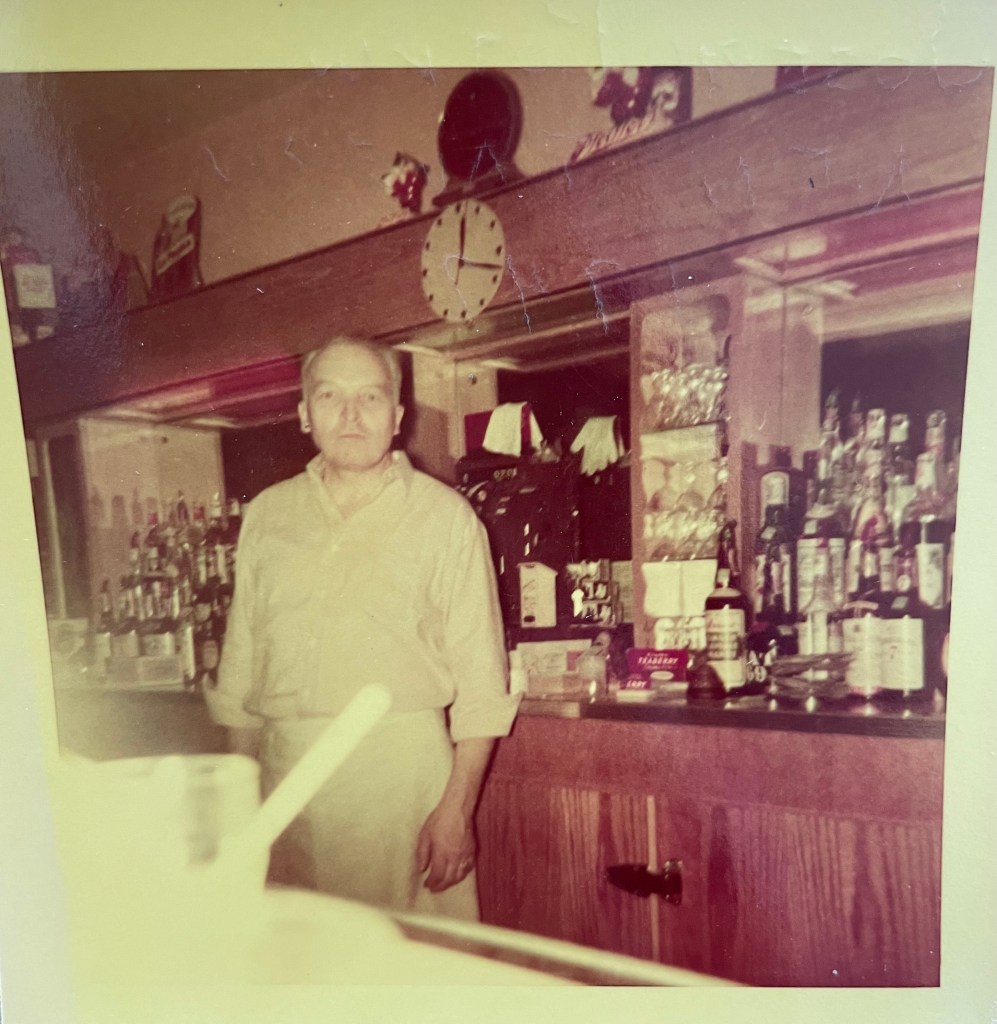
A VALUABLE TIP A Tower Operator at the Diamond Tower in Tesch, a tall handsome man, used to stop by the tavern about half-way thru his shift and enjoy a couple shots and beer for chaser. He would visit for a little while. Then he would buy a bag of Planters Peanuts before he returned to work. Jokingly one time I asked him if them peanuts were his lunch. He kind of laughed and told me that the peanuts would absorb the smell of beer and whiskey on his breath, in case a railroad official would stop in to check out the tower.
#2 Three Schaffer fellas were in a bar in Chicago, one of them got hiccups really bad. The bartender said
I have a cure for them. He took a good slice of lemon (wedge) and sprinkled 3-4 good drops of Angusta Bitters on the wedge and said to chew on it to get every bit of juice out of it. It is a miracle tip. Back in Schaffer I called it Dr. Buckshot’s Hiccup Medicine.
Fella stops in tavern late in evening, (1930s or 1940s) and tells Joe Potvin, the proprietor that it looked like a small person laying along the side of M-69 just West of the Potvin House. He asked someone to watch bar and goes investigates, sure enough it was a 12-year-old boy, Boy was brought to the hospital, dead on arrival. The boy was a grandchild of the Robert Foster Family who owned the store in Schaffer near the tavern. They were raising their grandchild. A Carl Johnson, a deputy of Delta County and brother-in-law of Joe, investigated the accident. A young resident was found to have a recently busted headlight on the side of his auto which matched the side of road the boy was hit, but nothing ever came of it.
In the mid-30s Joe Potvin was staying with his parents just SE of Sacred Heart Church. He was returning on foot late at night, after closing the tavern. A couple local thugs waited in hiding near the church to jump him and take the cash receipts from him, during the scuffle, Joe yelled for help and it woke up the housekeeper at the church rectory, she turned on lights to see what was going on and the thugs fled. They did not get the cash. Joe always praised the housekeeper for her kind deed. The next day Lence Richer, Joe’s cousin checked the tire threads in the gravel and solved the attempted robbery. My dad would never reveal who it was. After thought: I never thought of it over the years, I knew Lence very well, if I would have asked him, he would have told me.
Father Pelletier served as pastor of Sacred Heart Parish in Schaffer 1946-1949. Sometime in the late 70s my dad asked me to go thru papers in the safe and we would decide which ones we would burn. There was a paid off mortgage on the house to Fr Pelletier. I asked what that was and my dad went on to tell me the story. While the tavern was being close to being finished in 1947 Fr Pelletier stopped in to see how things were going. My dad was the general contractor, he had borrowed close to $50,000 from John Green FNB of Esky. He was over his budget and still needed more money to finish. He told Fr that and he asked my dad how much? $6,000 ish. Fr said “give me a mortgage on your house and I will loan you the money”. He Did. He was paid off promptly over the years. Whenever he traveled thru Schaffer, he would always stop in to visit my parents. Yep, parish priest had an interest in the new tavern. Quite a finance story.
During the 50s & 60s Joe Potvin would use 3 – 4 tons of potatoes for the restaurant. For quite a few years. Joe Butryn would provide the majority of the potatoes he raised on his own farm. It was a big deal when he came over with his truck load of potatoes. The potatoes were peeled and eyes removed by Joe’s children; during school time they were peeled on Wed night and cut into real French Fries on Thurs night in the potato room located in the basement of the tavern. During the busy summer season, it was common to peel 250 to 300 lbs for the week-end. I described them as the real French Fries above. because my dad used to say that because each potato portion was crimped on four sides it was described as a French Fry. He said Potato portion cut into four smooth or square sides were Shoe String potatoes, somehow over time that description got lost. I like to bring that up when we are at a restaurant and someone orders French Fries. Ask Rose😊
DOG TAG STORY
When Joe Potvin moved from the old place in late 1947 to the new place, he placed the dog tags in a cigar box and stored them in his desk. After he sold the place in 1970, he took them home. His son asked him for them to make a memorial. He shaped a piece of butternut lumber in the shape of a dog tag. When he asked a WW II veteran Louis Viau to rout the corners, he said sure, I brought the box over with the slab of wood, after routing job I showed him how I was going to place the tags in alphabetical order on the plaque. While removing the tags from the cigar box, I said, oh here is yours, I handed it to him and for what seemed like several minutes, he just held it in his hand in silence and stared at it, I can only imagine what he was thinking. He had forgot what had happened to his tags. There were two, he let me take one for the plaque. After we were done with the plaque he said let’s go in the house and I want to show my wife. Quite a touching moment.
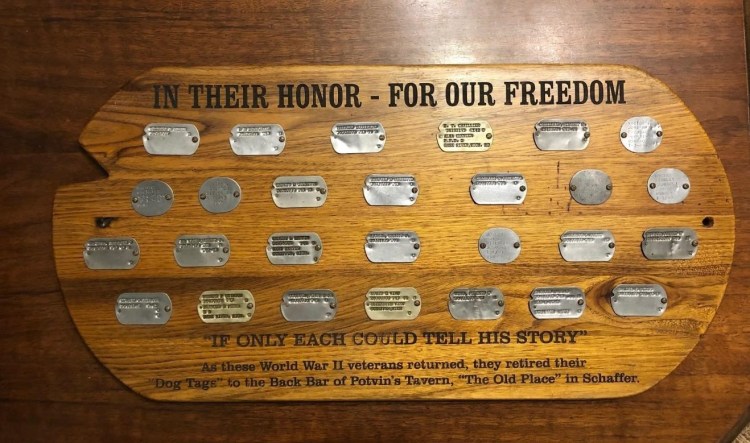
As these World War ii Veteran’s returned, they retired their “Dog Tags” to the Back Bar of Potvin’s Tavern, The Old Place in Schaffer.
Top to Bottom Left to Right
Gilbert R. Auger, L.H. Beauchamp, Raymond Bussineau, R. T. Chailler, Wilbert R. Chailler, Victor Joseph Frossard.
Maurice Gauthier, Leeland J. Gibbs, Ernest E. Guenette, Isadore E. Guenette, Theodore E. Guenette, Joseph Guindon, Walter Stanley Hojnacki
Raymond J. LaFave, Robert J. LaVigne, Ernest L. Martin, Ernest T. Michel, Joseph Royal Mitchell, Lawrence D. Quist, Donald W. Savage Edward G. Seymour, Hubert F. Seymour, Percy J. Stoffel Jr, Louis C. Viau, Phillip T. Viau, Raymond J. Viau, Walter E. Witte
HONORING A WW II VETERAN
Legionnaire and Auxiliary members from the Rheaume-Knauf American Legion Post 438 of Bark River, gathered at BR-H Schools to celebrate Veterans Day with students and staff, but to also honor fellow Veteran Mr. Louis Viau. During the celebration, the BR-H High School Choir sang the National Anthem and the Patriotic Festival. The Village Singers of Bark River also were present and sang This Land is Your Land.
Legionnaire Joe Potvin presented the following in honor of Veteran Louis Viau:
Today we are honoring Mr. Louis Viau. At the age of 20 he enlisted in the U S Army in
December of 1942. His wishes were to join the Army Air Force. After processing he was sent to
Ft Bragg, North Carolina, and to his surprise he was assigned to the 326th Glider Infantry Regiment of the newly formed 13th Airborne Division. In addition to his glider infantry training, he was trained as a combat medic.
QUESTION: 1. Can anyone tell us what a glider used during WW II is?
2. Can anyone tell us why they used gliders?
Gliding was very dangerous and a thankless job. They did not receive hazardous pay or wings as their fellow paratroopers. A poster designed by the glider troops that began to circulate around their barracks explained their plight “join the glider troops, no jump pay, no flight pay, but never a dull moment”
Not until July of 1944 would the glider troops receive their hazardous pay and glider wings.
A significant number of gliders, 4,190 were built at Kingsford, Michigan by the Ford Motor
Company. A total of 15,000 were built for the WW II
The CG 4A glider Mr. Viau rode in held 13 infantrymen and 2 pilots. It was constructed with a plywood floor and a steel tubing frame covered with a canvas skin. It also had small windows. It was nicknamed a “Canvas Coffin”. Two gliders would be towed by a C-47 twin engine aircraft. It was a two-hour ride from England to France. At a certain point in France the C-47 pilot would unhook the tow line and the mission of the two pilots began, to land the glider safely.
Unfortunately, many crashed and the soldiers were either seriously injured or killed.
The History Channel has shown a documentary about the glider troops called “Suicide Mission
Glider Pilots” which covers their history thoroughly. Also, a glider built at Kingsford is currently being restored by the Dickinson County Historical Society and they plan to have it on display in the next two years.
A neighbor of Mr. Viau recalled that Mr. Viau told him years back that on one of his landings the glider landed and stopped short of colliding with a railroad embankment. As the soldiers exited the gilder, they looked over situation and remarked how lucky they were to have avoided a crash, almost immediately they came under German gunfire and the action began. He also stated that if a glider survived a landing later it could be retrieved. Two high poles were set up holding a hoop which was attached to the tow line of the glider; as the C-47 came down to hook the hoop. As it began to climb back up it would really race the engines to get the glider off ground, the occupants got the ride of their life.
Mr. Viau’s parents were of French-Canadian ancestry, his 1st language being French, so while serving in France he was his unit’s interpreter, whenever there was a question, issue with the French people he was called upon to interpret the conversation.
He was awarded the Bronze Star.
He was discharged in December of 1945. His father served in WW 1. Mr. Viau the oldest brother along with three of his brothers served in World War II. Another brother served with American Occupation of Germany. His youngest brother served in the Koran War. One of Mr. Viau’s sons served in Vietnam. One could proudly say that he belongs to a family of patriots. Louis is a Past Commander of Post 438. Mr. Viau is married to Marge for 61 years and they are the parents of 6 children. Incidentally Mrs. Margaret Viau the former cook in the kitchen of your school is their daughter in law. On behalf of American Legion Post 438 we congratulate and honor you for your dedication and service to our country.
Bad Mistake
One local fella came into the old tavern disguised with an authentically looking toy pistol and told the proprietor, Joe, “this is a hold up and give me all the money, when he went to the till the fella yelled it was a joke” the owner got very upset over it, it was some time after the first robbery attempt, and turned him into the law enforcement. He got into a lot of trouble over what he thought was a good prankster. Again, my dad would never say who it was.
Tough Venison
A friend of the proprietor, Martin Witte used to drop off some venison for the fellas. In the old place. The tavern was an old hotel, the second floor had rooms, so a few old pensioners, plus one or two working for room and board were staying there. Usually on Sunday after Mass my dad would cook a breakfast for them. This particular Sunday he included some recently dropped off venison, while trying to eat it some with false teeth, good teeth or no teeth could barely chew it, it tasted good but very tough. My dad thought, for being from what looked like meat from a yearling, it sure was tough. Ended up throwing it away. A few days later Martin stopped by and during the visit he asked how the venison was, my dad did not like to slap the mouth that feeds you, so to say, but said kindly it was a good but a little tough for what looked like a small deer. Martin began laughing and told him he had shot a coyote and cut up the hind quarter into small steaks.
One Day a farmer-logger Bill Savage, who lived North of Schaffer, on a hot summer day, decided to ride his work horse across the woods to the Schaffer Tavern & Hotel, and purchase some beer, he rode the large horse into the old place thru the front door, surprising everyone in there, got his beer and rode it out the back door. There must have been some dents in the old floor.
Sometime in the mid-90s I wanted to get the recipe for making Boudin, my folks had passed and I was in line for some Pork Blood. I don’t know what had happened to my Ma’s recipe so I called a couple of the old French residents still around Schaffer but no one had it. My Aunt Blanche who was in a nursing home, she must know, I thought; she forgot. She told me why don’t you call Lena Taylor I am sure she should have it. I did then after Lena told me the details, she told me she got the recipe from my mother. Full Circle.
Joe Potvin had bought his family a full-blooded Alaskan Husky from a breeder in Maine, it came by train to Bark River. The dog use to pull a sleigh during Winter and he would hire one of his bartenders Oscar Guenette to guide dog and sleigh to bring his son on long rides in Winter. One hot summer day his son tied Butch to the front of the family car, a 1937 Plymouth Sedan. Butch went under the car in the shade. My mother loaded up the 4 kids and was in route to her mother in laws on the other side of Schaffer, not knowing the dog was tied to the front of the auto. M-69 was gravel in those days and it was about a ¼ mile drive, my mother thought there was an emergency brake problem because of a drag feeling as she drove down the highway. When she arrived and stepped out, the dog also managed to get out all mangled, skin, blood, showing all over, she would not let us out to see it. I don’t remember how she got in touch with my dad, she must have walked to the tavern, had my grand-pa watch us, the only thing I remember is my dad showing up with his 32 special rifle and bringing Butch to the rear of my Grand Pa’s yard and shooting him, that was a sad day.
There used to be a large hill just West of Schaffer. It was a very popular spot in Winter for sledding and skiing. There were kids there all the time. It was unique because it was high and the only one like it around. The county decided to rebuild the road between Schaffer and Bark River, evidently someone knew that hill was full of gravel and the many years of Winter fun was spread out over four miles.
I remember walking to school after Halloween and seeing most of the outdoor toilets on the way to school laying on their side or back. It was an annual prank. And the old people were not very happy.
Frank Moraski the local garage owner always dreamed of owning a good hunting dog. He ordered one and paid quite a bit for the dog. It was to come by train into Bark River. Martin Witte knew the depot agent in Bark River Carl Huss. Martin requested he notify him as soon as the dog arrived in Bark River. As soon as dog arrived Martin took a mutt over to the depot and exchanged the dogs. Carl notified Frank and told him the dog had arrived. He picked him up and when he opened crate and found the mutt he was very upset. Short time later Martin stopped by and heard the complaints and how he had got bilked. Just before he was about to call the breeder, Martin told him he had the dog.
“Abbey” a World War I veteran who worked for Bill Zick on his farm would stop in and have one beer. he was a kind, quiet old fella. Anyway, one of the first times I waited on him he asked me if I knew how to mix a “Cincinnati” Never heard of it. He told me ½ Beer and l/2 7up. It seemed like, every time he stopped in after that, he would ask me that question. He wanted me to make sure I knew what a “Cincinnati” was I guess.
There was a customer, a Ronald Carey from Hardwood, who worked in the woods. On occasion if he was on a toot he would stop in and drink beer, when it was lunch time he would go out in his car, eat his lunch, after he finished, he would come back in and continue drinking beer like it was his job. He was a good worker but he had a thirst for beer once in a while. He finally quit the woods and he and his wife bought a tavern in Wisconsin, I guess he could be there all the time. He was really a good guy.
In 1939 Henry Boucher a 19-year-old was cautiously driving slow during a very foggy evening, near the Ten Mile Bridge known then as Vachon’s Bridge, later Tommy Pach’s Bridge. I don’t know what they call it today. An auto driven pretty fast by Peter Seymour (Ste Pit) rear ended Boucher’s auto which sent Boucher into the windshield of his car, as a result Henry was killed. Told to me by Henry’s sister.
Barroom Coincidence
Joe Potvin (B S) and Bill Longtine from Wells were sitting in the Alley Cat Lounge in Anchorage, Alaska. A waitress made a remark about those two from Michigan. A moderately dressed fella was at the other end of the bar who heard her, he was a regular and inquired who was she talking about, she told him. He approached us and said are you the fellas from Michigan, I said yes. He asked where we from, I usually start with the U P, then Escanaba. This time I just said Schaffer thinking I was going to throw him a curve, right away he asked what is your name and I told him, you are not Joe’s son are you? His mother. a Ms Foster owned the store in Schaffer for some time and he lived there a short time, he knew everybody in town. His name was Bob Foster, found out later his dad had the same name. He also knew Bill’s dad Charles Longtine who owned the Buck Inn at one time. We became good friends; he was an operating engineer and worked construction. Whenever he would be in Anchorage occasionally, he would touch bases. After he retired, he bought a motor home and would winter in the Southwest. Once in a while he would come to visit his sisters at Flat Rock, one was married to Fred Marenger and the other was a housekeeper at the Catholic Church. When he was visiting his sisters in Flat Rock, they would come out to the tavern for Fish Fry and to see me. The first time he had to take a picture of me and my dad.
SCHAFER GOSSIP
When tending bar, you were pretty much in the know of what was happening all over the village good or bad. The secret was to keep your mouth shut and take it all in. Only certain friends would you ever discuss the gossip. If some of the “STUFF” ever got out the bartender, was in deep mud. One of my dad’s rule was, if a married couple got in an argument never take a side, the consequence was they would both end up hating you.
It was comical to hear some of the comments. If a new priest was assigned to the parish, if he said Mass, say in 45 minutes he was a good priest; if it took an hour or more, he was a bad priest.
The parish would publish an annual report of parishioner’ contributions all on one report. It was funny when certain ones would start comparing who gave what.
Donald Kozlowski
One of the tavern patrons, Don a bachelor farmer would stop in during the day in his barn clothes, cow manure all over his boots, and clothes. He would smell like a barn. He was a funny gossipy fella, liked a few beers, and sometimes was neglectful to his cows. He would be hanging out at the tavern all day and would end up milking his cows late at night. People would complain to him about his smell, but he would just laugh it off. Around 39 years of age his bull attacked him and injured his leg quite badly. It was black and blue from his hip to his ankle; he was told by many friends he should see a Doctor. They told him that he could get a blood clot with that leg in that terrible condition. Around this time, he took his pick up and chased the bull down and really rammed him. He was a big fella and was bragging how he got the bull back. Anyway a few days later at 39 he died in his sleep, coroner’s report, he died of a blood clot.
“Uncle Henry”
He was not my real Uncle; he was a brother to my Uncle George. He served in WW 11 in the European Theater. He was a lineman and was discharged as a Sergeant. After being discharged from the US Army wound up with a job in a saw mill, he worked on pole line construction, as he was an excellent lineman. Unfortunately, he developed a drinking problem and could not hold down that type of work. When he wasn’t drinking, he did some worthwhile projects. When Uncle George died suddenly at the early age of 47, he worked the farm until my Aunt Blanche disposed of the property, he was great assistance to her. He also was handy at carpentry and renovated a barn for one of his nephews. As time passed, he drank more and more eventually and worked there the remainder of his life.
My mother tended bar on occasion, but was more comfortable working around the kitchen or dining room. She could never stand the sight of false teeth even though she was an RN in her other life. Some of the fellas knew that, so when Uncle Hank (Henry) was in town, after he had a few they would tease him stating that he had a nice set of teeth, how could you keep them so nice after all these years? He would say they were false; they would continue after him until he would take them out and slam them on the bar, “There You Are! my mother would move to the other end of the bar quick, saying “Henry put your teeth back in your mouth for goodness sake” OK Lil, then he would.
He was proud of his service in the Army and liked to talk about it. When he was drinking a lot he had a weakness, if the fellas would ask him to sing Lillie Marlene, he would sing a couple lines and start crying.
When he returned from the service, he gave my dad a 32 special automatic pistol to keep for his protection. He always said he took it from a dead German Officer.
One time his nephew Louie and great nephew Ken visited their Uncle Hank. he had two pots on the stove going at the same time, they had a beer or two and were enjoying the visit. Once in a while he would get up and stir the kettles; he had one stick that he used in both of them. It smelled pretty good as time passed, finally one of them asked them what he was cooking, he said he was preparing a bouillon and they were welcomed to have some with him. They asked why he was making so much he said he was making only one pot full, he had his stockings, t-shirts and shorts in the other kettle. They said they would take a rain check on lunch.
One time he was stranded in Schaffer and needed a ride to LaBranche, A friend of mine Joe Lippens and I happened to stop at the tavern for a beer. Uncle Henry asked for a ride to LaBranche so we did.
When we got to his small trailer, after unloading 3 or 4 cases of beer for him, he invited us in for a beer. He had a stew going on the fuel oil heater, no cover on it. We probably spent an hour or two there, we had to shoot his 8mm a couple times then he shot a couple to show us how good he could shoot. We had more than a couple of beers, lots of fun with him as usual. This was on Saturday afternoon. I was tending bar on Sunday afternoon when Joe Richer stopped in; he had made his weekly Sunday trip to check on his brother-in-law in LaBranche. He also stopped by and visited with Uncle Hank too. This Sunday Uncle Hank had a chicken bone stuck in his throat from the stew he was making on Saturday. He was eating crackers trying to push the bone down, but was having a difficult time. When he went to work the next morning the sawmill owner thought he should go to a Dr. His wife drove him to Dr Jones in Menominee a very experienced ear, nose, and throat specialist. After examining him he took a tool and went down his throat, latched on to an object and removed a beer cap from his throat. He had a box full of items he had removed from people’s throats over the many years he practiced, but this was the first time he removed a beer cap. When we were standing around visiting in his trailer one of the beer caps must have flew into his stew, you just use to pop them off with the church keys. Old Uncle Hank provided some pretty good memories. God bless his soul.
Talking about annoying items, one early evening while Lillian was tending bar, Ed Polka brought in a friend, a stranger to all in the bar. After the friend was there a while, he asked my mother for an empty beer glass and a small glass with water in it. The fella preceded to dip his finger in the water and circle his finger around the inside the top of the beer glass creating a very loud annoying squeal.
RESCUE OPERATION
One evening while tending bar a young fella stopped in on a Thursday night for gas. Naser would fill up gas storage tank every Friday. Most of the time there would be gas left over on Friday. On occasion we would run out on late Wed or Thur. It was Thursday evening, no gas stations open at night in Bark River, so the fella came out to Schaffer. We were out of gas. “Oh gee my girlfriend is out in the car and she is going to have a baby, I need to get to the hospital and I am out of gas”. Fortunately, there was a responsible person at the bar, Mary Shiverski, and I asked her to take over while I drive the couple to the hospital in Escanaba. I had a new Dodge Cornet with a 318 engine, the girl was having contractions, making pain noises probably 15 or 16 years old, and I was driving 80 -90 wherever I could, fortunately that night there was not much traffic. I dropped them off at the hospital, relieved she did not have baby in auto. A couple days later he picked up his auto and I asked him how things were going, just fine, She had baby shortly after I dropped them off, close one.
Several years later I was invited to Hannahville Graduation which was held at the Dells Supper Club. The adults were having cocktails and someone asked what was the contents of this particular cocktail and someone else suggested, ask Rose’s husband, he used to be a bartender. So I explained. One of the ladies, probably because of Rose’s last name a bell was rung. The lady asked me where I tended bar and I told her. She went on describing the above story. She was sure surprised when I told her I was her chauffer. Her child was now a teenager. Like Paul Harvey the rest of the story.
YOU NEVER KNOW ABOUT THE FELAS AT THE BAR
In 1970 my dad, brother George and I attended an organizational meeting for our township centennial. I ended up with the job of researching the village of Schaffer. Louie Bouchard was at the bar when we returned and asked me what we were up to. Louie was a steam pipe fitter (instrument man at times.) Bachelor, WWII veteran in the Pacific Theater, as a Navy sea bee. He was quite stubborn at times, when discussing anything, one time I remember in a heated argument, he stated “You can’t tell me anything I know everything.” in a very heavy statement. He did drink sometimes too much. He was a very smart man. A true barroom character. So I tell him what I was up to. My dad knew that the name of Schaffer was named after an important person, but that’s about all. Louie says when I worked in construction in Milwaukee Area around 1955 or 1956 there was quite an article about this Schaffer person. He said it was in the winter months while he was laid off. The Escanaba Daily Press at that era use to have a feature page about some particular subject in the U P and really laid out a couple pages of research about the subject and did this once a week on the week-end.
Later I went to the micro fish at the city library, after spending quite a bit of time I did run across the article. From that info I found his obituary. I ended going to Marquette Historical Society and finding much more info. Found out from there where his house was, quite a historical mansion, it was still in the family name but they were no residents. There was a caretaker there. Thank You Louie
ORNERY
A fella who worked at P & H, He was a big man and liked to stop for a drink or two before going home, He was the shot (7 crown) and beer type that you don’t see much anymore. He would jokingly say when he was ready to leave, if Alice doesn’t have supper ready, I’ll raise hell with her, if it’s ready I won’t eat.
TOOTH HEALTH
Louie and Jule at certain times would tell me “take care of your teeth Buckshot you don’t want to have false teeth”. My mother used to take us to the dentist and in college I had a phy ed teacher at Northern, he must have been sponsored by the dental association, he always spoke about the importance of dental health. Between my mother, customers and the phy ed teacher I still have all my teeth at 80.
Thanks to the Good Lord too.
THE GOOD SAMARITAN
A Fella who had a heart of gold, sometimes dipped into the beer too much, was an NCO Korean War Combat Veteran and had a large family, always worked to provide for his family. He heated his house with wood. He harvested the firewood from his father’s land which was a couple miles past the tavern, with a farm hay trailer and tractor. On his return with the load of firewood he had to pass the tavern. It was early Christmas Eve afternoon when he stopped for a beer. Later a couple well-dressed fellas stopped in and inquired if we knew of anyone who had firewood for sale. They had a large SUV with a large trailer. Somebody at the bar told them maybe the fella at the other end might have some wood to sell. They approached him and made a deal, he sold all of it. Had a few more beers and went home with an empty trailer behind the tractor. On Christmas Day they were out of wood so he and his wife went out and spent part of Christmas Day getting more wood. Needless to say, the tavern was closed that day. With a house full of kids, his wife was a saint. She was from Missouri, if someone asked him where his wife was from, he would say” Misery”, of course she wasn’t around. His favorite song was “Pop a Top”.
PUZZLED
A great lakes sailor, 6’ 6” huge man liked to drink, sometimes way too much. He was a jovial type, bachelor, WWII Army Veteran. He was off the lakes for a week or so for his nephew’s wedding. Shortly after he arrived, he was on a toot with some friends.
He showed up at his nephew’s weeding reception, clean cut, all dressed up in a suit, ready to celebrate the event. As the evening went by he got as they say, loaded and navigated to his auto and sat in the driver’s seat, with legs stretched out on the gravel. Evidently he had to take a pee, so he pulled the long penis out and peed, feel asleep in that position. Someone who had saw the scene told others at the bar. His brother was a rancher with a large herd of white face. The son in law of the rancher from Milwaukee another big fella, remembered one time when he was at the ranch they were dehorning cattle and he remembered the spray they used to stop the bleeding, It stuck very well. He asked his father in law where the stuff was, so he went and got it. He took a paper plate and cut a hole in and placed it around the long penis carefully, so he would not awaken him or get the paint on his nice suit. He sprayed the blue paint real good. Probably the most decorated penis ever.
After the reception, my dad and I cleaned the place up and it was 4 or 5 when I went by the kitchen window and there he was fumbling around his car to get going.
I opened up at noon and shortly after, here comes Walter, he was very nervous. He had dropped his billfold on the floor when he was leaving in the early evening and one of his relatives gave it to my dad to hold, it was loaded with money. He inquired if any one turned it in and I gave it to him, he was happy. He bought some take out beer and left. I knew he was puzzled, he normally would have a few drinks, especially after a night like that. He was in a hurry to go somewhere. He was supposed to be around for a week or so, that’s what he said when he first came. He was staying at a friend’s place and a few days later I ran into Lois and I told her the story. She said he only had a couple beers and left. She said he was very nervous and he had get back to the lakes, the plan to stay around for a few days fell thru. I only wish I knew what was the rest of the story.
Another fella who helped at the tavern was Jule Frossard. He lived with his brother in Tesch. He was a older, fine person, always wore denim trousers, suspenders and logger boots with high heals. He was deaf and dumb. Everybody called him the “Dummy”. One of his duties after walking from Tesch to Schaffer was to go to the Schaffer Post Office and get the mail for the tavern, then the bartender would draw a glass of beer for him. One thing that was pitiful to us kids was while he was working on a project with our dad sometimes he would try to advise our dad to do it in a different way, making all kinds of funny noises. Sometimes he was not very happy when our dad did not understand his advice. He was not much of a drinker but was very helpful to the tavern owner.
Break-In on Sunday Afternoon
One time I was tending bar on a busy Sunday afternoon when a neighbor (the Michels) living across the street called and told me a boy just opened the coal bin door and crawled in. Ed Polka had just stopped in and I asked him to come and help me. I asked him to stand at the top of stairs and if the boy got passed me for him to stop him, Ed was a large strong man and I knew he would like this job. I checked the basement and the boy was not in the furnace or potato room, so he was on the other side, pop storage area and beer cooler. I asked Ed to keep watch on him while I called law enforcement and secured the coal chute outside. The boy did not come out. I called the house and somebody relieved me then I relived Ed. When the State Police finally arrived they apprehended him downstairs and had him in the car for a while. It turned out that his parents were customers and I was unaware the boy was theirs. He was still in the State Police Car when they arrived, evidently the police called them. We did not press charges but I had asked the State Police if he did not have a record to give him a real scare. The parents were not very happy with me for calling the state police, I told them I did not know who that person was that broke in and I wasn’t going to try to apprehended him myself. They were still not happy with me. Oh Well!
“A CHICKEN BOUILLON”
Year or two after WW II – Schaffer Hotel & Bar – Schaffer. Michigan
(Schaffer was a French-Canadian Settlement)
Most of the time the Bouillon organizers would make the rounds in the middle of the night and gather their birds before the big party. They didn’t refer to it as stealing, just conning, picking up a chicken or two out of each of the coops around the village or the country side. The size of the party determined the number of chickens that were needed sometimes up to a dozen or more. On occasion the chicken owners took their flock more seriously and called the law, sometimes the revelers would have to pay the price for the fun.
In the East end of the old tavern there was living quarters. Buck LaVigne stopped in the tavern on the way from work, on a late Saturday afternoon and was enjoying a beer with Mr. Leo Guindon, an elderly gentleman, when the door from the living quarters flew open and out came a rooster with Ray Viau in hot pursuit, with a meat cleaver in hand, in white shorts with bright red stripes, as they had been butchering the chickens in the kitchen of the living quarters. The bartender Joe Potvin. yelled at Ray to get the rooster back into the kitchen. In the melee Mr. Guindon remarked in French, that rooster looked just like mine. He lived in a large house across the highway from the tavern and had a flock of chickens. Ray had splattered his clothes with chicken blood at one of the former Bouillons so for a laugh, someone bought him a pair of red and white striped shorts to dress him up for these important occasions.
That evening as the bunch began to gather for the Bouillon, someone mentioned that while Mr. Guindon was at the tavern in the afternoon, he mentioned the similarity between the Rooster they butchered and his own. As they sat down to enjoy their bounty someone suggested that they should invite Mr. Guindon over to taste some delicious chicken bouillon. One of the party walked over to his house and invited him over, he was so happy because they invited him. He enjoyed the party very much, as he was leaving and thanking the bunch for inviting him to the Bouillon, Keto DeMarse one of the revelers, told him in French, which most in attendance spoke, and I was told that the saying is much funnier in French, as it rhymes also, “What is yours is ours and what is ours is yours”
Needless to say Mr. Guindon was not a happy Frenchmen the next morning when he went to feed his chickens and his rooster was missing and a few of his old hens.
Marie Taylor was a bartender in the old place. There was an older Swedish Fella who lived in the hotel, worked for his room and board cleaning up tavern and other odd jobs. He also liked to nip whiskey. His name was Gust Johnson, he pronounced it Gus Yonson. His nickname was Porky, when a lady was attractive to him, he would refer to her in his broken English as his “Speckled Trout”. Porky always wanted to marry Marie. One day Marie and Lillian Potvin arranged a Wedding Ceremony outside, in the rear of the old place. In the picture you can see the backdrop of the ceremony, the old outdoor toilets. The big day came, Marie or Lillian invited the local grocer Nelson LaBonte to officiate the wedding ceremony equipped with a Sears Roebuck Catalog. Louis Picard was the Best Man. It’s too bad, but Porky actually thought he was getting married. Jim Potvin is the little lad, another witness.
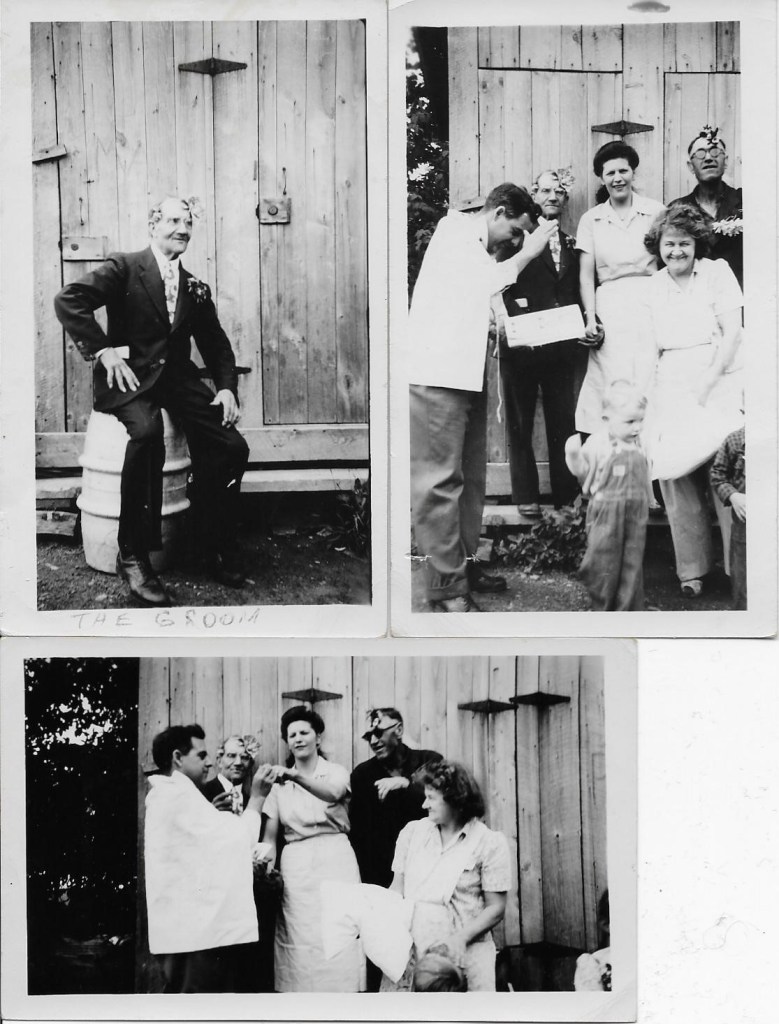
Nels along with his wife owned the store in Schaffer.

Joseph Potvin’s Automobiles
1st there was a ’37 Plymouth 4 door standard sedan, brand new.
2nd around 1947 A 1941 Buick, belonged to the owner of the Hiawatha Hotel and Bar in Escanaba, it was low mileage and just like knew. It was Black, 4 door, straight eight engine with a very long hood on the car. The great novelty was a radio in it, what a deal.
3rd around 1950 A 1948 Buick with a straight eight engine. It was a four door and a very large car, wine colored
4th around 1957 a 1955 Chrysler 4 door, large V 8 green in color, would go 120 mph + 5th around 1965 a 1962 Chrysler 4 door, large V 8 Black in color.
6th around 1970 a 1967 Chrysler New Yorker, loaded, 4 door and large V 8, Black in color
For many years these large automobiles were used to chauffer the pall bearers following the hearse to the church and eventually to the cemetery.
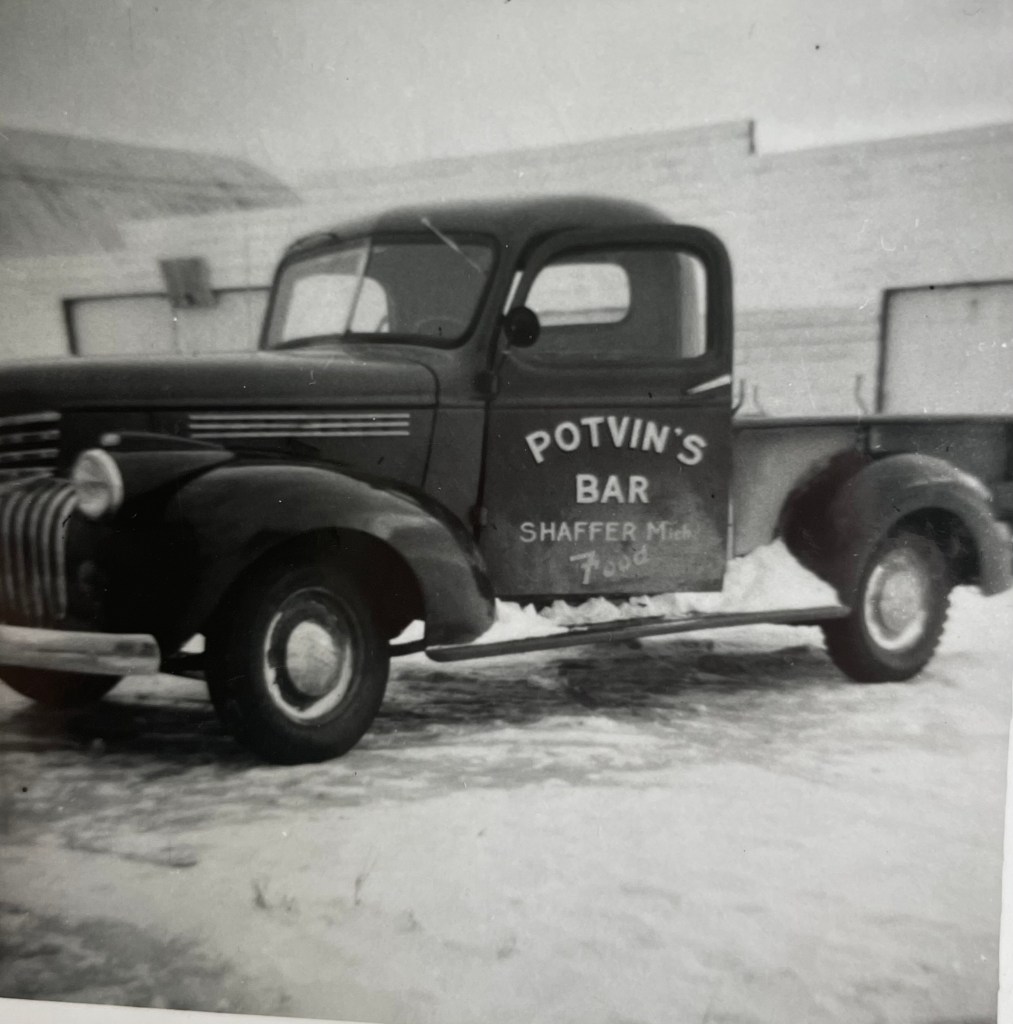

POTVIN NAME
I knew vin meant wine in French. I used to ask my dad what Pot meant, he always stated something negative but he did not know exactly, just that it meant negative; it could mean no or bad. In French Pot is pronounced PA and he said in French that was part of the phrase that meant no or something negative. Once in a while English speaking people would say oh, it means a pot of wine, no wine, or bad wine, etc.
One day at dinner at the sugar bush in Ste Justine, Quebec, a person was passing around the wine. When he offered it to one of the workers, the worker stated “Pa Vin”(“Pas de vin”) (meaning he did not want any) and he passed on the wine.
Later that day I asked the person passing the wine (who was bilingual) what the worker meant when he said “pa vin”(“Pas de vin”)*, he said it was a another way to say he did not want any wine. The fella who was passing the wine, who was a retired world history professor, explained that in his research of the name Potvin, he found out that in France, there was a wine produced that was a very fine product, very sought after, but it was used primarily to bribe high French Officials, hence it was referred to as “Pa Vin” (Pot de vin). It was a very fine wine but used in a negative or in a criminal way.
That’s probably why in the days when French Canadians , who came to the small town of Schaffer to visit their relatives, always liked to stop at Potvin’s Tavern. It was probably a novelty to those who knew the translation of Potvin; also the fact, that the owner and his wife of the establishment were bilingual.
While on a mission in Germany in 2004, I was in a beer hall conversation with a bilingual German female college student, friend of Lynette, and the definition of our name, Potvin came up. She stated that the letter w is pronounced as a v in German. Claudia Otto from Ingolstadt, Germany stated as follows:
Potts Wein translates into English as Potts (means bad) Wein (means wine) Gee, I thought quite interesting.
Person passing wine at Sugar Bush was Benoit Chouinard, Marcel’s father in law. Person stating” PaVin” was “Bruno”.
Benoit Chouinard is Marcel’s father in law. Every spring Marcel & Family migrate to Quebec to make Maple Syrup. Marcel and his wife Anne rent a sugar bush from her cousin. They return to Oregon around May 1 when Marcel has to report for work.
An exchange student from France. a classmate in 2019 stated that in France they will use the Phrase “Pa Vin” to mean to pass something on. I wonder about a statement above about the passing wine to the fella and he said PaVin, if he meant to pass it by him, not that he did not want any?
Harold DeLoughary would recite this poem when he would pass a cemetery:
Remember Man as you pass by
As you are now, so once was I
As I am now so you will be
So pause and say a prayer for me.
Then Leona DeLoughary, his wife, would recite:
May they rest In Peace, Amen
Harold and Leona were Rose (Neubauer) Potvin’s grandparents
Phil Jacobs of Ralph, Michigan married to Irene Cotnoir of Schaffer. Phil owned a bar in Ralph. On occasion he would go on a toot. He would lock up tavern and drink by himself for a few days. After sobering up he would run the business without no drinking. He was quite a boxer and had gloves for anyone who wanted to box, most of the time he was the winner. He sold the bar and went to work on the railroad. He had a keen sense of balance, he could run on the railroad rail for as long as he wanted without ever falling off. His claim to fame was, he could stand on his head on the bare back of a horse.
Alice Farrell- Tim Farrell Alice was raised in Ralph.
(Phil had a son Don who also had a keen sense of balance and eventually became a world champion log burlier)
July 23, 1969
Schaffer Census by J P Jr researching the history of Schaffer for the Bark River Township Centennial. Schaffer Proper and surrounding neighbors within a ¼ mile or so of Centerville.
| Henderson | 4 | Racicot | 7 | Smitley 3 | Dupie 4 |
| Potvin | 7 | Viau | 7 | Bedard 1 | Meyers 2 |
| Moraski | 4 | Viau | 4 | Richer 3 | Taylor 2 |
| Bartosz | 2 | Gagnon | 1 | Richer 5 | Levesque 5__ |
| Gruscha | 1 | Leonard | 3 | Sobolewski 1 | |
| Lantagne | 2 | St John | 3 | Dault 2 | Total 166 |
| Guenette | 2 | Michel | 6 | S H C Church 2 | |
| Martin | 2 | Gilbault | 1 | Allard 2 | 85% Catholic |
| Vaver | 6 | Seymour | 2 | Constantineau 1 | |
| Taylor | 6 | Glovacki | 5 | Mercier 10 | Pach had store and lived |
| Tousignant | 2 | Canadians | 2 | Schermer 2 | 2 miles away |
| Lippens | 7 | Racicot | 7 | Derocher 5 | Canadians were iron |
| Taylor | 2 | Bolangie | 1 | Robinette 5 | ore explorers |
| Juneau | 4 | Taylor | 6 | Nelson 5 |
HUNTING STORIES
Lowell Potvin put up a beautiful blind on Potvin’s Whitney Property. I was tending bar, closed up 3:00am ish. Had to give Louie Bouchard a ride to a relative’s camp at Cornell. Got to bed around 5:30am. went to 11:30 mass at St Michaels in Perronville, had my hunting clothes with me and went out to Whitney Property, it was Opening Day. Lowell was just leaving his blind to go out to Stanley Novack’s store to get a can of black paint. He did not see a deer all morning. I planned to go to the West of where he was hunting, he said why don’t you go my blind and look it over. I did, nice job. I sat there for a few minutes, here comes a nice fork horn, I shoot it, drag it a ways from blind. Clean it out, then start dragging it to my car. Here comes Lowell with his can of paint. Where did you get that he sez? I said, right out of your blind. You son of a bitch. Well you told me to check it out.
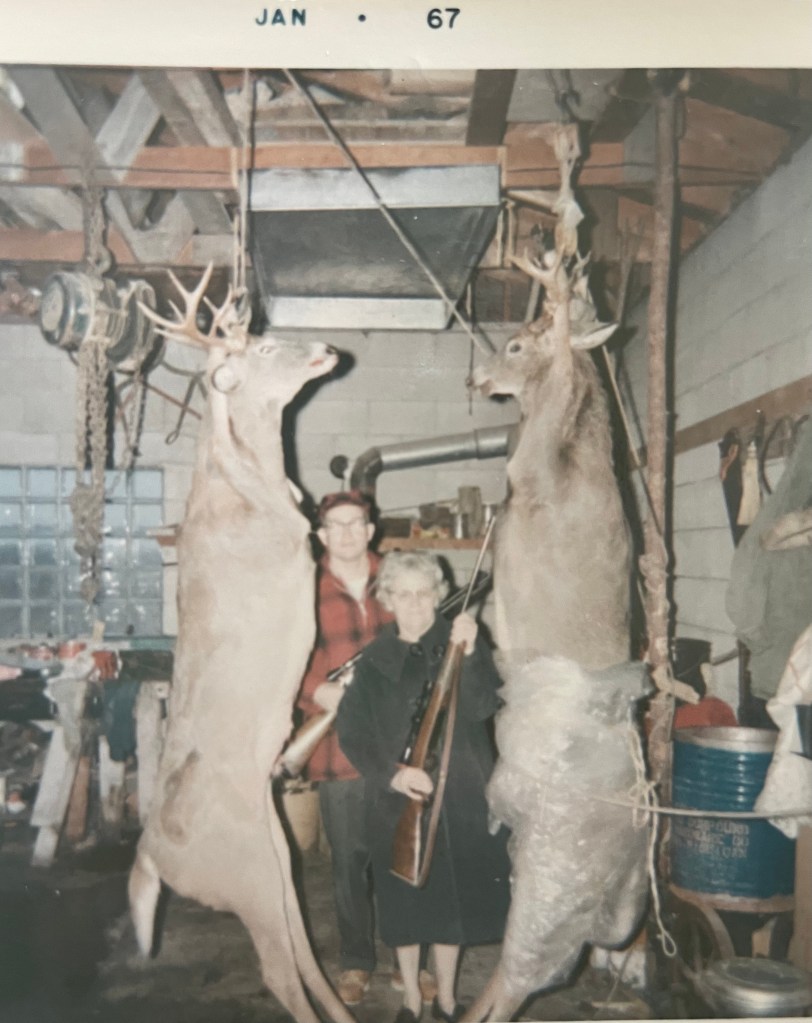
I was hunting out of my blind on the South 40 at Kamp Whiskey Jack. I was supposed to be at camp at noon, because of expected company. Around 10:00 am ish a squirrel was playing around the shack and hung around on the window sill. Thought that was cute, first time ever over many years. It hung for a while looking at me, then it crawled around the outside of shack and disappeared. Around 11:30 I decided to head for camp, it’s a ½ mile trek. Tried to open door, its locked, the damn squirrel must have rested on the wood latch and twisted it shut. No way to climb out of windows, I did have a chunk of fire brick I would put on the stove to heat it up. 8”x12”x 3” I tried to hit door with it several times to no avail. Sat back and wondered how long it would be before anyone came out to see how come I am not at camp, that could be hours. I rested for a while, it was nice and warm inside. I decided to try the concrete block again many good hits and finally got it open about a ¼”. Rested a while and then got really aggressive and finally after many blows, I manage to bust the wooden latch loose. I was a ½ hour late but I had an excuse.
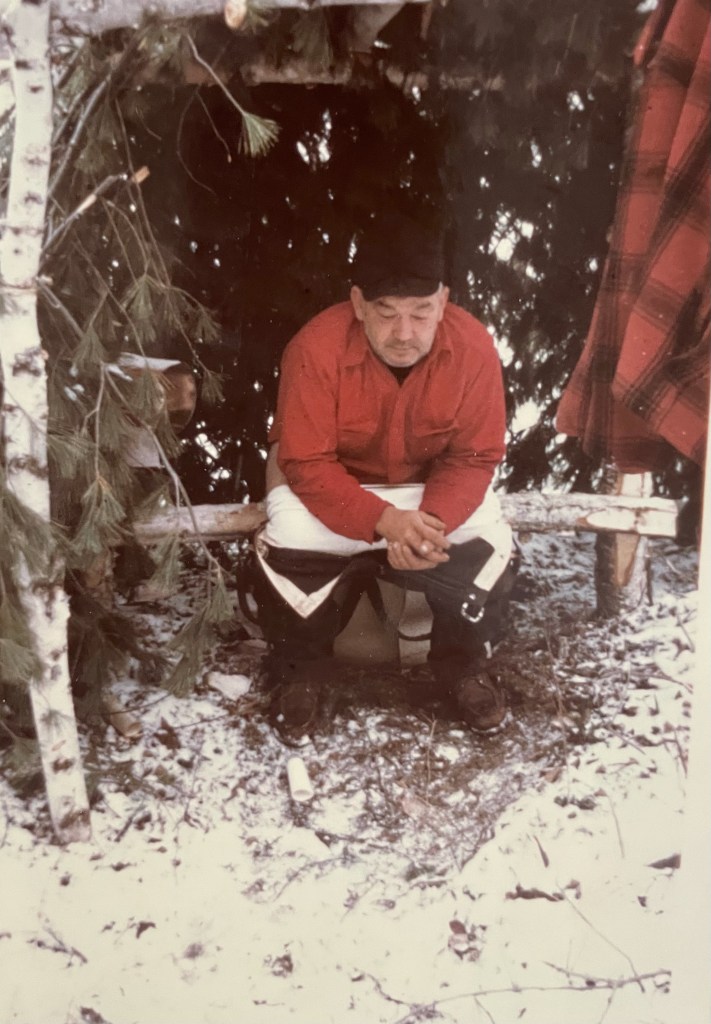
The hunting party was down to my Uncle Albert & I. He had the blind North of camp that he regularly was putting out feed for the deer. The two nights before season which started on Saturday he called and told me his knee was giving him a hard time and he could not make it hunting. He said take Marcel with you and he could sit in my blind and watch the deer. Friday Marcel came with me to camp. He was nine years old and could shoot his single shot 22 very accurate, young eyes, he had got partridge with it shooting them in the head. He sat in the blind Saturday morning and did not seen anything. In the afternoon he wanted to stay with me, he said he was boring out there. I finally convinced him to go. I hunted out of camp that year. Around 5 ish I heard little footsteps running to camp.
It was Marcel and he said I shot a deer, I said is it got horns? Dad it’s got antlers. I dressed up in heavy clothes and we took the pick-up out to the area. He did not know how many points it had. When we got to the deer it was dead and it was a 10 pointer. He was very excited. The next day we brought it to Schaffer to show my folks. I asked him how many times did you shoot it, he said quite a few, at first in head and then in neck, the deer started jumping around, he just kept shooting. The next day I went out to blind and counted 16 or 17 empty 22 casings. When we cleaned it there were bullets all over the deer. I guess he did not want it to get away. He was 10 on the 21’st 6 days later. The 22 was a lever so every time he shot it, he would have to extract the casing and insert another one and close the lever; he had to be a busy little boy.
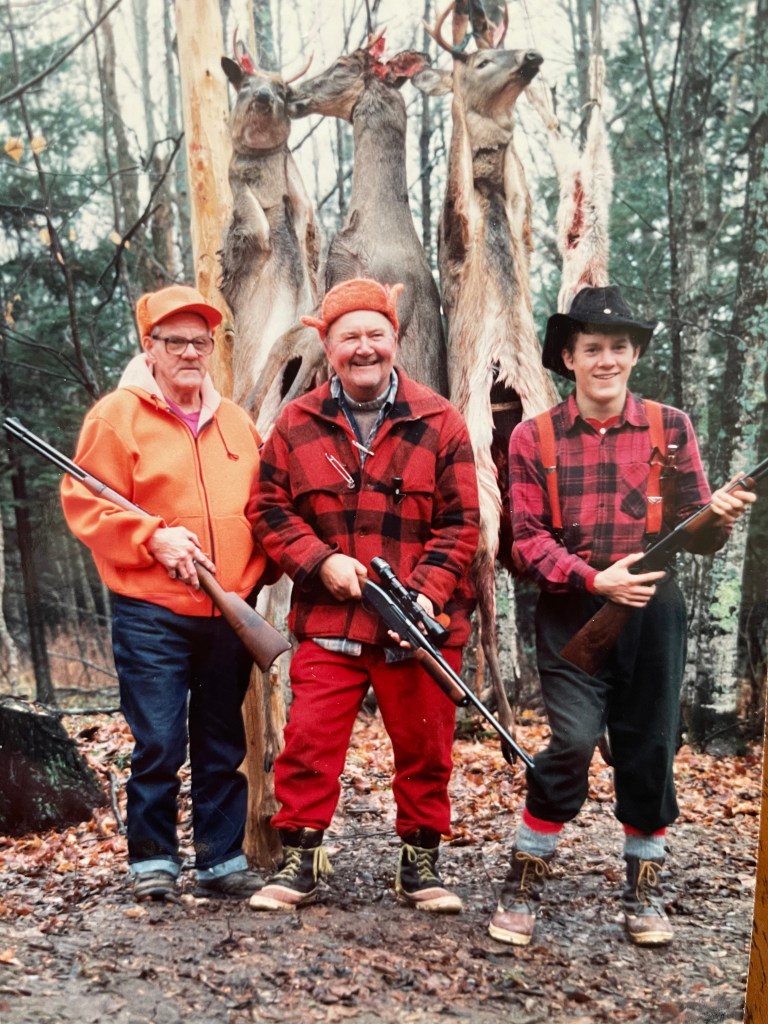
Calling Moose I was hunting with Reinhold Bittner and Company in Canada. One of the hunters, Zimmerman, had a tape recorder with instructions how to call moose. We played it and we were practicing It in camp, it could have been quite amusing if someone approached the camp and did not know what was going on. The next morning, I found a large piece of Birch Bark and made a Bull Horn. I was in a very remote area by myself, there were supposed to be no hunters getting into that area, except us. At one of the lakes I set up and after a while I began practicing my skills, maybe my unskills. I did a number of calls over a couple hours. It was getting close to noon and time to head to the rendezvous point where we got together and canoed across the river to get to the camp. It was very quiet frosty morning and all of a sudden I began hearing steps in the leaves behind me, I slowly began turning around with the 7mag rifle ready to shoot the moose when it came by me. To my surprise as the sound got closer, it sounded more like humans, sure enough it was two hunters who had ventured into that area from another direction. They saw the bull horn and asked me if I was the one calling. I said yes, how did it sound? One of the being a smart ass,” If you stepped on a bull moose’s nuts he would make a sound like that”.
That took the wind out of my sail, but I still wonder to this day why they took so much time to sneak up on me, getting me excited, heart pumping, etc. and me thinking that a moose was approaching.

I was doing cemetery business with Jim Michel, formerly of Schaffer. He worked as a fireman for the city of Milwaukee all his working years. He inquired about my family, I mentioned the oldest is also a fireman, who works as a Smokejumper in the Pacific Northwest and Alaska. He said it would take somebody from Schaffer to do a job like that.
 Schaffer Quips